


St. Louis Soars
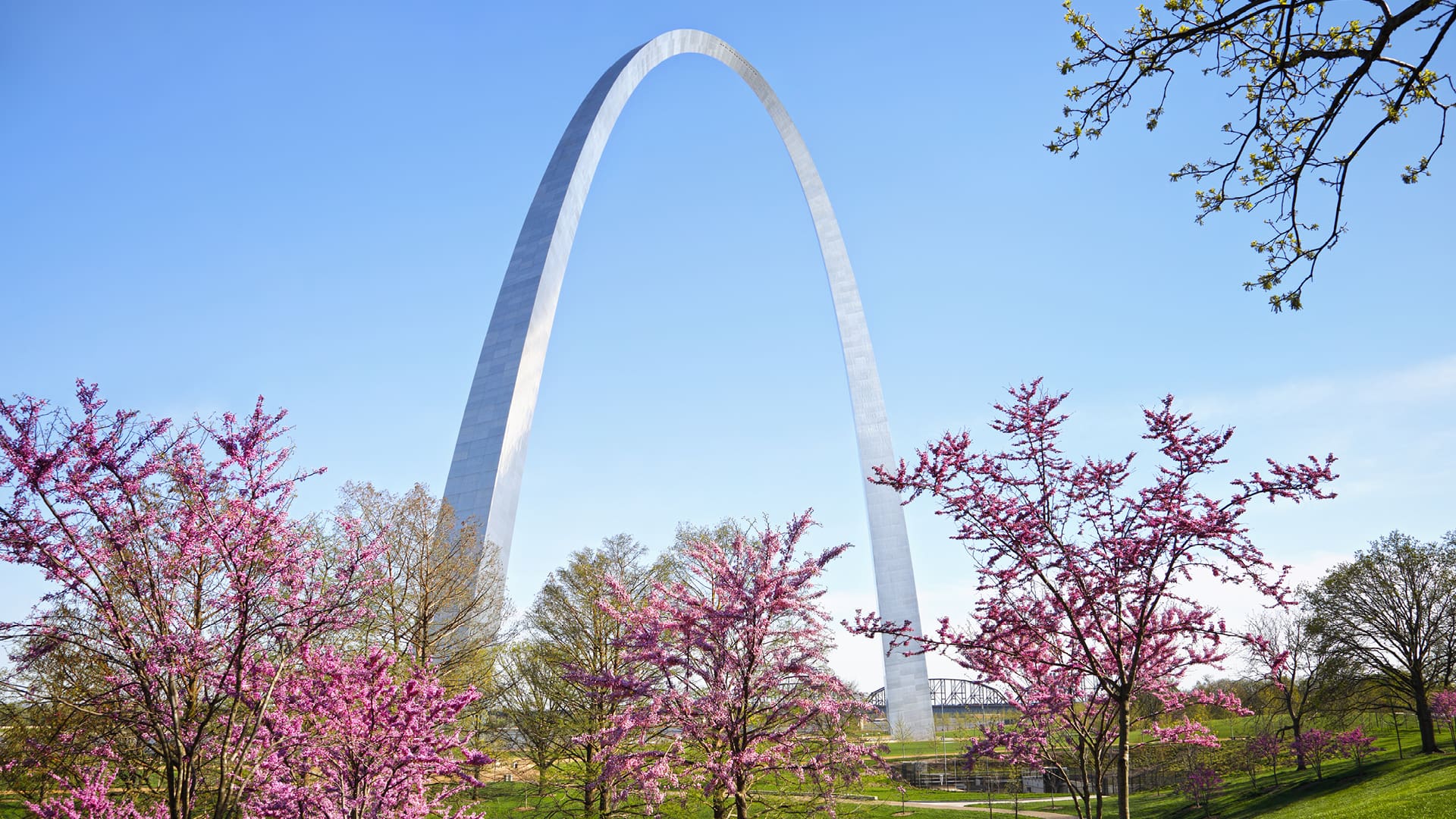
By Debbie Franke, courtesy Explore St. Louis
It’s possible to visit New York City and not see the Statue of Liberty. It’s also possible to visit San Francisco and not see the Golden Gate Bridge. That’s hardly true about St. Louis and the Gateway Arch.

The towering arch rises 630 feet into the Missouri sky and is the centerpiece of Gateway Arch National Park, which civic leaders envisioned in the 1930s as an interpretive site to explore St. Louis’s role in the nation’s westward movement.
It continues to deliver that historic message while also serving as a gateway to a Midwest city filled with great food, activities and attractions — many of them free.
Brad Dean, CEO of Explore St. Louis, recommended the Arch as the first stop on any visit.
“Start with the Gateway Arch,” he said. “It delivers an unforgettable beginning to any visit to St. Louis.”

The park’s 91 acres contain attractions and symbolism beyond than the Arch itself.
“That little area holds stories of many consequential events in American history,” he said.
The park, America’s smallest national park, covers the site of the colonial French town of St. Louis. French settlers were in the region in the early 1700s, and Pierre Laclede came up the Mississippi River from New Orleans in 1764 to establish the trading post that became St. Louis. The fledgling outpost changed hands — from France to Spain to France again — before President Thomas Jefferson’s Louisiana Purchase put it under the American flag in 1803.
The Old Courthouse, visible from the narrow windows at the top of the Arch, is within the park. This historic structure, renovated in 2025, was where Dred and Harriet Scott sued for their freedom in 1847 and in 1850, and where pioneer Missouri suffragette Virginia Minor sought, but failed to obtain, the right to vote in 1872.
Outdoor Finds
History gives way to cultivated nature heading west from the Arch only 5 miles away at the Missouri Botanical Garden. Its roots date to 1850 as the project of British immigrant Henry Shaw, which explains its informal name, Shaw’s Garden. One of its big attractions is the Climatron, a geodesic rainforest greenhouse, which opened in 1960 as one of the first geodesic-domed habitats.
More nature — and art — are just a couple of miles away at Forest Park, one of the largest urban parks in the U.S. It’s even larger than New York City’s Central Park. Its 1,300 acres contain the St. Louis Zoo, the Missouri History Museum and the Saint Louis Art Museum.
Museums and More
The Saint Louis Art Museum holds a collection of approximately 37,000 objects spanning 5,000 years of history and many cultures. Groups will find an ancient Buddha bust from Central Asia; Italian Renaissance marbles; paintings by Henri Matisse; South American ceramics; African carvings; evocative American scenes by John McCrady; and abstracts by artists such as Norman Lewis.
The Missouri History Museum’s focus is closer to home. One of its continuing exhibits examines the almost mythical 1904 World’s Fair, technically the Louisiana Purchase Exhibition, which attracted 20 million visitors. It celebrated the 1803 Louisiana Purchase and popularized consumer items such as waffle-style ice cream cones, peanut butter, Dr Pepper and puffed wheat cereal.

The ever-popular St. Louis Zoo has a direct connection to the 1904 World’s Fair. The Smithsonian Institution built a walk-through aviary for the fair, and St. Louis citizens bought it for $3,500 rather than see it dismantled and shipped to Washington, D.C. It was the first piece of the jigsaw puzzle that became the zoo. More pieces were added decade by decade, including an insectarium with a butterfly house.
The zoo has a second campus that is set to open in 2027. It’s the 425-acre St. Louis Zoo Wildcare Park about 15 miles north of the main zoo near the confluence of the Missouri and Mississippi rivers. This $230 million project focuses on endangered ungulate species (think giraffes, southern white rhinos, scimitar-horned oryx and Bactrian camels). Features include an interactive museum, safari tours and an 11-story observation tower.
In the Neighborhood
The proximity of major St. Louis attractions to each other is an advantage for tour operators, Dean pointed out.
“The time between attractions is short,” he said. “That lends itself to productive itineraries and opportunities to explore.”
He added that the city’s mix of neighborhoods is a bonus.
“Visiting neighborhoods that highlight history, architecture and food is the way you really get to know St. Louis,” he said.
An example is Cherokee Street, which Dean described as “Sesame Street without the Muppets” because it is loaded with character and lots of characters. It’s known for having a “beatnik vibe” and for shopkeepers, bartenders and residents who appoint themselves unofficial tour guides. Six blocks of Cherokee Street constitute Cherokee Antique Row, and the street has the city’s largest concentration of Hispanic bakeries, restaurants, groceries and shops.
The Cherokee Arts District, home to 30 cultural organizations and attractions, also warrants attention. Among its draws are the Pulitzer Art Foundation, the Walls Off Washington and the Fabulous Fox Theatre, a true entertainment palace built in a style called “Siamese Byzantine,” which is a conglomeration of Moorish, Far Eastern, Egyptian, Babylonian and Indian elements. The Walls Off Washington is an explosion of vibrant, colorful murals decorating buildings from sidewalk to rooftop.
Culinary Delights
Food choices abound in St. Louis, but to guarantee that visitors dine as the locals do, groups should keep both savory and sweet categories in mind. Barbecue (pork, beef and especially brisket burnt ends) is a given. First-timers are often surprised at the prevalence of toasted ravioli, a twist on classic Italian ravioli sometimes called the signature dish of St. Louis.
On the sweet side, gooey butter cake is featured on many menus, and sampling a cold treat at Ted Drewes Frozen Custard has been a tradition here since 1930. The Ted Drewes location on Chippewa Street is a veritable landmark for travelers on Route 66.


Tom Adkinson
Nashvillian Tom Adkinson continues his multi-decade career in travel journalism and travel publicity as an independent writer with time to roam. He particularly enjoys researching stories that include history, interesting personalities and the outdoors, especially destinations where trout hang out. He is a Marco Polo member of the Society of American Travel Writers.
You May Also Like




About Us

We're Select Traveler, Select Traveler, America's leading experts on affinity travel for banks, chambers of commerce, university clubs and other loyalty organizations. Find hundreds of articles and other free resources here.
The Latest Issue
Stay Connected!
Get the Select Traveler Minute e-newsletter delivered every month.